The Reserve Bank of India (RBI) will maintain the policy repo rate at 6.5 per cent during its upcoming June 8 announcement, considering the easing of retail inflation in April and the potential for further decline, indicating the effectiveness of previous policy rate actions, anticipate experts. Headed by Reserve Bank Governor Shaktikanta Das, a meeting of the six-member Monetary Policy Committee (MPC) is scheduled for June 6-8. The decision of the 43rd meeting of the MPC would be announced on Thursday, June 8.

Former environment minister Jairam Ramesh on Thursday virtually backed the non-governmental organisation Greenpeace in the backdrop of an Intelligence Bureau report warning that the NGO is a threat to the country's economic growth.

Undeterred by the stock market volatility, uncertainty due to the Ukraine-Russia war and high inflation, equity mutual funds continue to remain attractive choice for investors for the 15th straight month, registering a net inflow of Rs 18,529 crore in May on robust SIP numbers. This was higher than Rs 15,890 crore net inflow in April, data from the Association of Mutual Funds in India (AMFI) showed on Thursday. Equity schemes have been witnessing net inflow since March 2021, highlighting the positive sentiment among investors.

But much depends on govt action & global economy; Sensex gains in 2070 the biggest in five years

Tata Motors was the biggest loser in the Sensex pack, skidding 1.77 per cent, followed by SBI, Power Grid, Tata Steel, Infosys, UltraTech Cement, Titan, Larsen & Toubro, Reliance Industries and Maruti. On the other hand, IndusInd Bank, Bharti Airtel, Asian Paints, NTPC, HCL Technologies, HDFC and Sun Pharma were the gainers.

'During my visit to Japan and after meeting with Prime Minister (Shinzo) Abe, I gladly recall that in our joint declaration we mentioned Asia-Africa growth corridor and proposed further conversation with our brothers and sisters of Africa,' Prime Minister Modi said.
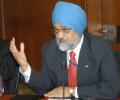
India should learn to live with high energy prices for rapid economic growth, said Planning Commission Deputy Chairman Montek Singh Ahluwalia after two of the state-owned oil companies hiked petrol rates this week.
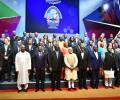
The pitch comes close on the heels of China launching its multi-billion dollar OBOR initiative

Meanwhile, for the fortnight ended March 20, deposits grew 11.42% y-o-y.

A study says shortage of skilled workers, inferior quality and inadequate highway infrastructure can defeat Indian carmakers.

'India has many attractive features for the long-term investor; it combines: A low per capita income, a young population, and a heavier presence of high margin, asset-light firms in the technology sector.'

Over 15 years, with seven per cent growth, the Indian economy will be three times bigger.

The rupee depreciated by 9 paise and settled at its all-time low level of 83.13 against the US dollar on Wednesday, weighed down by a surge in crude oil prices and strong American currency. Forex traders said the Indian rupee depreciated as the US dollar rose to the highest levels in six months. Moreover, elevated crude oil prices also weighed on rupee.

The Whole Price Index inflation figure for June is slated to be released tomorrow. "The WPI forecast is 11.12 per cent for June. . .the RBI is slowly withdrawing from its low policy rates regime and the trend is going to continue, given the inflationary pressure in the economy," IEG said in its monthly bulletin.

A careful reading of the national income accounts suggests that after a strong recovery from the pandemic, there has been a significant ebbing of dynamism over the last three quarters to more modest levels recently, note Arvind Subramanian and Josh Felman.
India will catch up with China by the year 2020 in terms of economic growth on the strength of its better efficiency of investments, an Asian Development Bank economist has said.

The BJP does 'empowerment and not appeasement,' Union Minister Mukhtar Abbas Naqvi asserted.

Borrowing from BRICS bank will help India avoid other kinds of politics emanating from the West. Overall, the BRICS institutions will necessarily adopt alternative ways of doing things based on their own cultural and socio economic needs, says M K Venu.

'The recent correction in indices has made the markets cheaper to invest for the long term.'
Industrial production is expected to dip marginally in the next 3 months due to rupee gaining strength against the dollar and declining non-food credit, even as petrol and diesel might become cheaper, the Institute of Economic Growth said.
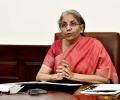
Expressing the government's commitment to continue with reforms, Finance Minister Nirmala Sitharaman on Thursday assured India Inc that it is ready to do everything required to revive and support economic growth hit by the COVID-19 pandemic. Stressing that there is a need to promote growth as it helps bring down poverty, she however said it would not be at the cost of inflation. RBI has been mandated to keep inflation at 4 per cent, with tolerance level of 2 per cent on either side.

JSW Steel (3.37 per cent), Tata Steel (3.33 per cent), Maruti (3.24 per cent), Power Grid (3.07 per cent), IndusInd Bank (2.95 per cent), Bajaj Finance (2.12 per cent) and Tech Mahindra (2.22 per cent) were among major gainers. On the other hand, Ultratech Cement, Sun Pharma, Nestle and L&T were the losers.
India needs to pursue an integrated approach to energy planning as high economic growth equalling or exceeding eight per cent would create much larger demand for energy in the next few decades, a study has said.

Modi attended the 20th ASEAN-India Summit in Jakarta. Secretary-General of ASEAN Dr Kao Kim Hourn also attended the summit.

Tata Motors was the biggest loser in the Sensex pack, tumbling 2.47 per cent, followed by Reliance Industries (2.44 per cent), Maruti (1.84 per cent), SBI (1.76 per cent) and Bajaj Finance (1.23 per cent).

There is a vocal constituency of educated, well-to-do, articulate Indian elites who would rather go with the idea that too much democracy is a liability. That India needs a spell of benevolent dictatorship. Of course, they have never lived under one, points out Shekhar Gupta.
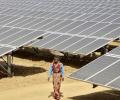
The push given to rooftop solar installation in the Interim Budget ties in with its high rate of adoption in Tier-II and -III cities of India. If original equipment manufacturers (OEMs) in the automobile industry, government, and the solar sector are to be believed, in cities of Rajasthan, Gujarat, and Kerala, 45-50 per cent of electric-vehicle (EV) users are employing rooftop power to charge their vehicles. This is compared to the national average of 25 per cent, say industry sources.

Modi will participate in the first-ever trilateral meeting between Japan, America and India and the 2nd Russia, India China trilateral, which is taking place after an interval of 12 years, on Friday.

...or just a Covid-era practice, asks Ajit Balakrishnan.

Foreign Secretary Vinay Kwatra on Wednesday refused to speculate on whether the G20 foreign ministers' meeting would be able to come out with a joint communique against the backdrop of widening differences between the West and Russia on the Ukraine conflict.

'What Jaishankar says is simplistic.' 'The past does not matter that much.' 'If we think that it does it is because we are not good enough at running the nation competently today and are searching for excuses why,' argues Aakar Patel.

Public investment is very crucial for GDP growth, says finance ministry.

The World Bank has approved loans totalling $1.75 billion (about Rs 13,834.54 crore) to fund India's PM Ayushman Bharat scheme and private investment to boost the economic growth. Of the total loan, $1 billion will go towards the health sector, while the rest $750 million will be in the form of development policy loan (DPL) to fill the financing gaps through private sector investment in the economy. The World Bank Board of Executive Directors approved two complementary loans of $500 million each to support and enhance India's health sector.

Concerned by GDP slowdown and unrealistic tax targets, the economists urged Finance Minister Nirmala Sitharaman to implement long-term structural steps like land and labour reforms. Warning against any off-Budget financing the economists said the government should prepare a statement of intent for its social, rural and welfare sector expenditure.

'To the believers of crypto regulations, I have only one question to ask, how will you regulate it?'
The Bank suggested reforms in infrastructure sector.

When I was leaving Pakistan and going abroad I had no feeling of happiness but today I am happy, Sharif said.
Across top 20 management campuses, the average salary offered this year is about 22 per cent more than what was offered last year said a report prepared by MBAUniverse.com. Among the institutes surveyed, IIM-A saw the biggest salary hike of 30 per cent, while Indian School of Business (ISB) witnessed a jump of about 19 per cent. The average domestic salary of the IIM-A graduates stood at Rs 18.75 lakh per annum. Banking and financial services were the biggest recruiters.
